
Sands Fence and Deck Alternatives: 2026 Comparison Guide
Last Updated: October 23, 2026
Quick Summary
The best sands fence and deck alternatives are wood, vinyl, composite, and chain link fencing, chosen by privacy, pet containment, budget, or low maintenance needs. Wood lasts 15-20 years, vinyl 20-30 years, composite 25-30+ years, and chain link 20+ years. Compare itemized quotes on 20-year cost, not sticker price.
- Installed privacy fence costs run $25-$45 per linear foot for pressure-treated pine and $35-$65 for vinyl.
- A 150-foot pressure-treated pine privacy fence typically costs $3,750-$6,750 before gates and removal.
- Cedar is the best wood for backyard fences in most climates, followed by pressure-treated pine and redwood.
- Over 20 years, a 150-foot vinyl fence costs about $8,300 versus $10,250 for pressure-treated pine.
- Ask contractors for itemized quotes covering removal, gates, permits, and post depth before signing.
Table of Contents
- Why Homeowners Look for Sands Fence and Deck Alternatives
- Fence and Deck Alternatives Evaluated Side by Side
- Wood Fence vs Vinyl Fence: Which Suits Your Backyard?
- The Best Wood for Backyard Fences and How It Ages
- Fence Installation Cost: What Drives the Total Project Price
- Fence Contractor Questions to Ask Before You Sign
- Lifecycle Value: Maintenance, Repairs, and Long-Term Cost
- How Fencementals Compares to Other Sands Fence and Deck Alternatives
- Frequently Asked Questions
Why Homeowners Look for Sands Fence and Deck Alternatives
Homeowners searching for Sands Fence and Deck alternatives usually want one thing: a clear picture of what a fence actually costs and how long it lasts. According to IBISWorld's fence construction industry analysis, the U.S. fence construction industry grew at a 2.9% compound annual growth rate from 2021 to 2026, reaching roughly $20.0 billion in revenue.
Below, we break down the real options, trade-offs, and questions worth asking before you sign anything.
Fence and Deck Alternatives Evaluated Side by Side
Fence and deck alternatives fall into four categories: wood, vinyl, composite, and chain link. The right pick depends on whether privacy, pet containment, budget, or low maintenance matters most.
The broader market is expanding. The Farnsworth Group's decking, fencing, and railing forecast projects the category growing from $5.1 billion in 2026 to $7.4 billion by 2033, driven largely by demand for lower-maintenance materials.
Wood, Vinyl, Composite, and Chain Link at a Glance
| Material | Best For | Maintenance Level | Typical Lifespan |
|---|---|---|---|
| Wood (cedar, pine, treated) | Privacy, curb appeal, budget flexibility | Moderate: staining every few years | 15-20 years |
| Vinyl | Low maintenance, clean appearance | Low: occasional wash | 20-30 years |
| Composite | Long-term durability, premium look | Low | 25-30+ years |
| Chain link | Pet containment, boundary security | Very low | 20+ years |
Composite brands like Trex, TimberTech, and SimTek appear in current composite fencing comparisons, though published specifications and pricing vary widely by line. Chain link remains the most cost-efficient boundary option, and black chain link has become a popular upgrade for homeowners who want security without the industrial look.
Wood Fence vs Vinyl Fence: Which Suits Your Backyard?
Wood fence vs vinyl fence comes down to two questions: how much upkeep you'll accept, and how much you'll spend upfront. Wood costs less to install and offers more design flexibility; vinyl costs more initially but needs far less attention.
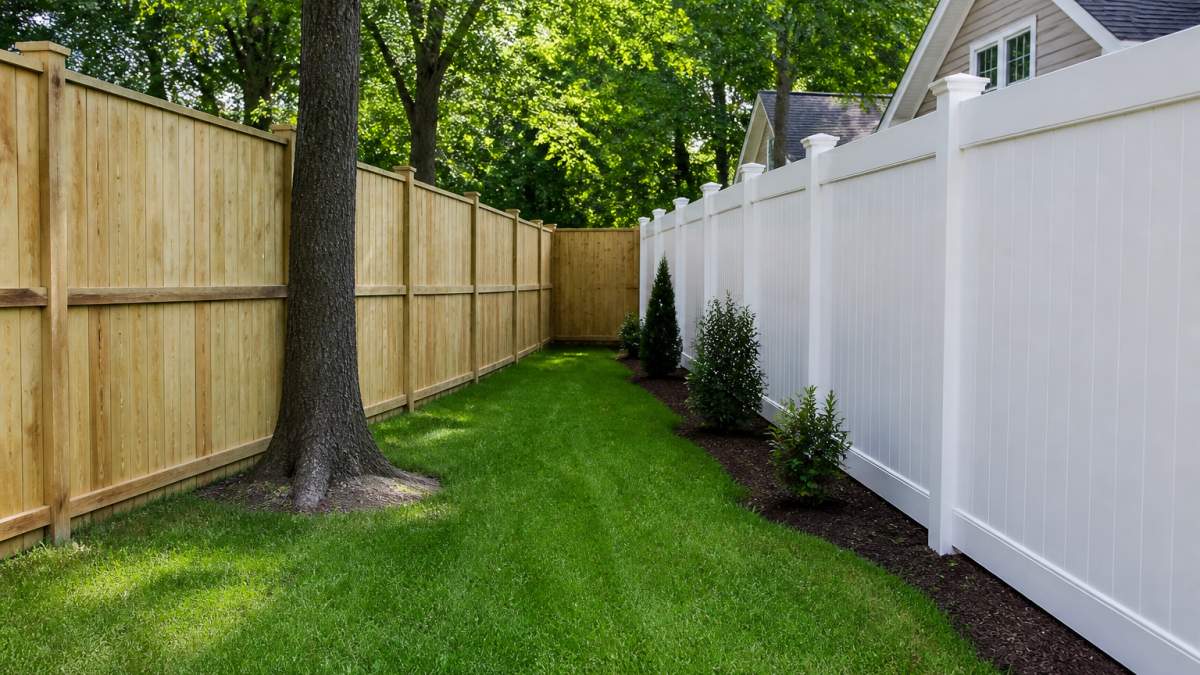
Wood wins on appearance for many homeowners. Cedar and pressure-treated pine take stain and paint well, and a well-built wood privacy fence delivers the seclusion most families want.
Vinyl wins on maintenance: it resists moisture, insects, and rot, and a garden hose handles most cleaning. The drawbacks are limited customization and higher upfront cost.
The Best Wood for Backyard Fences and How It Ages
Cedar is the best wood for backyard fences in most climates, followed closely by pressure-treated pine and redwood. Cedar's natural oils resist rot and insects, and it weathers to a soft silver-gray if left unfinished.
Each species ages differently:
- Cedar: Slow, even graying; holds stain well; naturally rot-resistant
- Pressure-treated pine: Affordable; needs sealing within the first year; can warp if installed wet
- Redwood: Excellent stability and color retention; higher cost
Oil-based stains penetrate deeper than water-based formulas and generally last longer between recoats; TWP 100 Series is a common option. Installation matters as much as species: posts set below the frost line and properly spaced rails do more for longevity than a premium board.
Fence Installation Cost: What Drives the Total Project Price
Fence installation cost depends on linear footage, material, terrain, gate count, and site access. Any contractor who quotes one number without walking the property is guessing. Below is how the total is actually built, with ranges to sanity-check a bid.
The cost formula
A fence quote is essentially:
(linear feet × installed cost per foot) + gates + removal + site work + permits = total project cost
Installed cost per foot bundles material, posts, rails, pickets, concrete, fasteners, and labor. Contractors quote it as a single per-foot number, then add line items for everything that isn't a straight run.
Typical installed cost per linear foot
These ranges reflect common residential installations on flat, accessible ground. Treat them as planning ranges, not quotes.
| Material | Installed cost per linear foot | What's included |
|---|---|---|
| Pressure-treated pine privacy | $25-$45 | 6-ft dog-ear pickets, posts, rails, concrete |
| Cedar privacy | $35-$60 | Cedar pickets and rails, treated posts |
| Vinyl privacy | $35-$65 | Panels, posts, caps, aluminum or steel inserts |
| Composite privacy | $50-$85 | Composite panels, posts, hidden fasteners |
| Chain link (galvanized) | $15-$30 | Mesh, posts, top rail, tension bands |
| Black chain link | $20-$35 | Vinyl-coated mesh and posts |
| Aluminum ornamental | $40-$75 | Panels, posts, powder-coated finish |
A 150-foot privacy fence is the most common residential run. At the ranges above, that's roughly $3,750-$6,750 in pressure-treated pine, $5,250-$9,000 in cedar, $5,250-$9,750 in vinyl, and $7,500-$12,750 in composite before gates, removal, or site work.
Line items that change the total
| Cost driver | Typical added cost | Why it matters |
|---|---|---|
| Walk gate (3-4 ft) | $150-$400 installed | Hinges, latch, and a framed opening |
| Drive gate (10-12 ft) | $600-$1,500 installed | Wider frame, heavier hardware, possible bracing |
| Old fence removal and haul-off | $3-$8 per linear foot | Disposal fees and labor; often excluded from base bids |
| Slope and terracing | 10-25% of base cost | Stepped panels, longer posts, extra concrete |
| Rock or root excavation | $50-$150 per obstructed post | Augering around obstacles takes time and equipment |
| Permit | $50-$500, varies by jurisdiction | Often the homeowner's responsibility unless delegated |
| HOA architectural review | $0-$250 | Application fees and resubmittals if specs are rejected |
| Stain or seal (wood) | $1.50-$3.50 per square foot | Usually a separate line from installation |
Worked example: 150-foot wood privacy fence
- 150 linear ft × $35/ft = $5,250
- One 4-ft walk gate = $275
- Removal of existing 150-ft fence = $750
Change the material to vinyl at $50/ft and the same job lands near $8,875. That spread is why comparing lump sums across materials tells you almost nothing.
Questions that expose a soft quote
- Is the per-foot price based on actual measured linear footage or an estimate?
- Are posts, concrete, and caps included, or billed separately?
- Is removal and disposal in the number?
A quote with line items is far easier to compare than a lump sum.
Fence Contractor Questions to Ask Before You Sign
The right questions separate a professional crew from a risky hire. Ask these before signing anything:
- Are you licensed and insured, and can I see proof?
- Is the quote itemized, and what could change the price mid-project?
- Who handles permits, property line verification, and HOA approval?
That last one matters more than people expect. A crew that leaves ruts, nails, and debris behind tells you plenty about how they treat the rest of the job.
Lifecycle Value: Maintenance, Repairs, and Long-Term Cost
Lifecycle value is the total cost of a fence from installation through repair and replacement. A cheaper fence that needs restaining every two years can cost more than a pricier one that needs a rinse. Here is the ownership math.
Annual ownership cost by material
| Material | Upfront (150 ft) | Annual upkeep | Major repair risk | Expected service life |
|---|---|---|---|---|
| Pressure-treated pine | $3,750-$6,750 | $150-$400 (clean, seal, spot-stain) | Rot at post bases, warped boards | 15-20 years |
| Cedar | $5,250-$9,000 | $100-$300 (stain every 2-3 years) | Graying, board replacement | 15-20 years |
| Vinyl | $5,250-$9,750 | $0-$75 (rinse) | Cracked panels, post shift | 20-30 years |
| Composite | $7,500-$12,750 | $0-$75 (rinse) | Fading, panel replacement | 25-30+ years |
| Chain link | $2,250-$4,500 | $0-$50 | Bent mesh, rust at coatings | 20+ years |
Annual upkeep includes materials and the value of your time if you do it yourself. If you hire staining out, add roughly $1.50-$3.50 per square foot of fence face every recoating cycle.
The 20-year math
Take a 150-foot privacy fence and compare two paths over 20 years:
- Pressure-treated pine: $5,250 install + about $250/year upkeep × 20 = $10,250, plus likely board and post repairs in years 12-18.
- Vinyl: $7,500 install + about $40/year upkeep × 20 = $8,300, with panel replacement as the main risk.
- Composite: $10,000 install + about $40/year upkeep × 20 = $10,800, with the longest remaining service life at year 20.
The cheaper fence isn't always the cheaper ownership decision; the crossover point depends on how long you stay and how much upkeep you do yourself.
Repair costs to budget for
| Repair | Typical cost |
|---|---|
| Replace a rotted wood post | $150-$400 per post |
| Replace a wood privacy panel | $100-$300 per panel |
| Replace a vinyl panel | $75-$250 per panel |
| Replace a chain-link section | $100-$300 |
| Re-stretch sagging chain link | $100-$250 |
| Reset a leaning post (any material) | $200-$500 |
Post failure is the most expensive common repair because the concrete collar and surrounding panels usually come out with it. Proper post depth and drainage at installation are the cheapest insurance against that bill.
What actually extends service life
- Post depth below the local frost line prevents heaving and leaning.
- Concrete set above the soil line and sloped away from the post sheds water instead of trapping it.
- Galvanized or coated fasteners stop the rust streaks that stain wood and vinyl.
One overlooked factor: deck inclusion in new homes remains below 18%, according to U.S. Census Bureau data cited by LBM Journal. That means most outdoor living upgrades, fences included, happen on existing homes, where matching an established yard and grading takes more care than new construction.
How Fencementals Compares to Other Sands Fence and Deck Alternatives
Fencementals is a locally owned, veteran-operated fence contractor serving the Midlands, built around the complaints homeowners bring us about Sands Fence and Deck alternatives: vague pricing, upselling, and messy job sites.
What that looks like in practice:
- Itemized, upfront pricing with no surprises after the first day
- No upselling on materials you didn't ask for
- Clean work sites, cleared daily and left tidy at completion
A Fencementals customer in Lexington put it simply: "Got three quotes and Fencementals was the most straightforward: no upselling, fair pricing, and they finished the job in one day. The wood fence looks great and our dogs are finally contained."
If you're weighing Sands Fence and Deck alternatives, start with a quote you can actually read line by line.
Frequently Asked Questions
What are good alternatives to Sands Fence and Deck?
Homeowners comparing Sands Fence and Deck alternatives usually weigh three things: material, contractor, and total project cost. On material, wood, vinyl, composite, and chain link each solve a different problem, from privacy to pet containment to budget. On contractor, look for written estimates, proof of insurance, and references you can actually call. Locally owned, veteran-operated companies such as Fencementals serve the Midlands with wood, vinyl, and chain link installation and publish their pricing so you can compare before you commit.
How do I compare fence contractors fairly?
Ask every contractor for the same document: a written, itemized estimate that lists materials, linear footage, post spacing, gate hardware, removal of the old fence, and cleanup. Compare the line items, not the bottom line. Confirm license and insurance status, ask how long they have worked in your area, and request two or three local references. A quote that looks cheaper often excludes removal or uses thinner posts. Fence installation cost differences usually trace back to those details rather than labor rates.
Is wood or vinyl fencing better for a backyard?
It depends on how much upkeep you want. A wood fence costs less upfront and can be stained or painted any color, but it needs resealing every few years and can warp in humid conditions. Vinyl costs more initially and holds its color with little more than a hose-down, which suits homeowners who want low maintenance. For pet containment, both work when posts are set deep enough and the bottom rail sits close to grade. Ask your contractor which option handles your soil and slope.
What should a fence installation estimate include?
A complete estimate names the material and grade, total linear feet, post size and spacing, concrete for post setting, gate count and hardware, old fence removal, and site cleanup. It should also state who handles permits and property line verification, and whether the price is fixed or subject to change if the crew hits roots or rock. Anything missing from that list is a cost that can appear later. Get the scope in writing before any work starts.
Which fence material lasts the longest?
Composite and high-quality vinyl generally outlast untreated wood because they resist rot and insects, and composite brands such as Trex, TimberTech, and SimTek are commonly compared for exactly that reason. Cedar and pressure-treated pine can last decades too, but only with regular sealing and repair. Chain link is durable and inexpensive but offers no privacy. Longevity depends as much on installation as material: proper post depth and drainage decide whether any fence stands straight after ten years.
Comparing Sands Fence and Deck alternatives shouldn't require a spreadsheet and a leap of faith. Fencementals offers free quotes with itemized pricing, veteran-operated crews, and a clean-site promise on every job. Get a quote from Fencementals and see exactly what your fence will cost before you commit.
